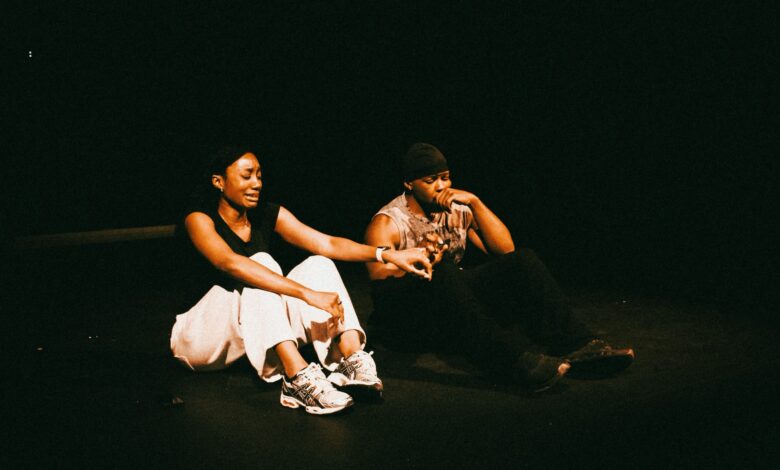
In Her Eyes, I’m a Good Man, written and directed by Mo Korede, is part of Theatre Peckham’s Young, Gifted & Black 2026 season. True to the programme’s mission, this play is not just about love in its many forms, from friendship to romance, but is also a love letter itself to the vibrancy and richness of Black British life.
Imbued with music from across the Afro-Caribbean diaspora, Korede illustrates how relationships are shaped by our community, both the people in it and the cultural expectations that dictate it. At the play’s centre are two childhood best friends, Kay (Victoria Nwaesei) and Jay (Seyi Falas), who have been each other’s rocks since they were young. The chemistry between Nwaesei and Falas is palpable, and they expertly execute the agonising intensity and intimacy of their characters’ emotions as they navigate their dating lives with other people. While the two characters might not necessarily see each other as soulmates, the body language they speak, the shared banter they have, the looks they give to each other, suggest otherwise.
This will-they-won’t-they plot relies on fairly predictable obstacles, such as meddling exes and tortuous instances of bad communication. What keeps the show dynamic is its high-octane sound design. DJs RUSH:HOUR and Bridget Ekelectic deliver an immersive, hypersonic soundscape that transforms the stage into various propulsive scenes of Black party culture, such as a Nigerian club during Detty December and Carnival in the sultry heat of London summer – it’s impossible to not feel yourself bopping to each song that’s played and the audience is even invited on stage at points to join the party. Mo Bangura and Zainab Lawal, who form the play’s ensemble and act as the “curators of vibes”, also lift the play, shapeshifting continuously into a range of side characters around the main couple and injecting plenty of comedy. Together, the four performers create an almost sacred atmosphere of joy that keeps the audience gripped throughout. While at times this energy drowns out the plot and blunts its more poignant moments, it also speaks to the worlds around us that shape who we are.
An unexpected highlight of the night was a short extract from Assistant Director Effie Ansah’s own play, which Imagiphoria Productions, the company behind In Her Eyes, I’m a Good Man, has committed to staging alongside two other works from the creative team. The few minutes we saw were tightly crafted and beautifully performed, and I’m very excited to see the full production. Overall, this commitment to platforming the varied stories of, and voices within, the Black British community is vital and exemplary.
In Her Eyes, I’m a Good Man Rehearsal Photo (Credit: Tanasha Chege)
Cast & Crew
Mo Korede – Writer/Director Effie Ansah – Assistant Director Mya Onwugbonu – Producer Imagiphoria Productions – Production Company Shane Afolabi – Executive Producer Bashiie Baptiste – Project Manager Yemurai Zvaraya – Movement Director Arianna Muñoz – Sound Designer RUSH:HOUR – DJ Composer Bridget Ekelectic – DJ Composer Jahmiko Marshall – Lighting Designer Phyllys Egharevba – Set/Costume Designer Janhavi Shivalkar – Stage Manager Tanasha Chege – Rehearsal and Production Photographer Lynelle Kisuule – Marketing Manager Seyi Falas – JAY Victoria Nwaesei – KAY Mo Bangura – ENSEMBLE Zainab Lawal – ENSEMBLE
Love in Lagos – An African Reimagination of Romeo & Juliet
With Love in Lagos, M54 Studios brings the spirit of Nigerian pageantry to the heart of South East London. Romeo and Juliet has been adapted, retold and revived more times than anyone could count, yet this production finds a new dimension within the text, reshaping it into something between pantomime, historical tragedy and folktale.
Mention Romeo and Juliet to anyone and they will no doubt point to the familiar themes: star-crossed lovers, feuding families, inevitability of fate. Director Mofe Duncan transplants these well-trodden throughlines to 1960s Nigeria, specifically the first of October, the day when the country cast off British colonial rule, marking the dawn of newfound independence.
While the play broadly follows Shakespeare’s structure, it is never derivative, nor afraid to depart radically from the canonical text. The feuding houses are two powerful bloodlines – the Yoruba Adeyemis and the Igbo Okonkwos – vying for a federal constituency seat in Lagos. As with the original play, a son and daughter of these rival families meet and fall for one another before learning each other’s surnames. By the time this truth emerges, it is too late for them to simply untangle themselves from each other’s lives as lovers and they both are wracked with the gravity of this reality. Should their families discover their affair, it would unleash a war that could tear through Lagos. You might expect a version set in this period to belabour the political significance of colonialism and independence but this production chooses to not to make it the defining focal point; instead, the weight of family lineage is explored in great depth. Unlike the Montagues and Capulets, the feud in Love in Lagos carries deeper weight, intensified by tribal division and the high stakes that come with trying to claim a voice in a newborn democracy.
Some may see this refusal to linger in the broader postcolonial context as a missed opportunity, but the direction the play takes instead is just as effective and compelling.
Unlike in Shakespeare’s original, the audience is invited to throw itself wholeheartedly into the action, becoming something like a chorus. Even the band is drawn into the action, reacting to events on stage. At one point a soulful saxophone rendition of ‘My Heart Will Go On’ is drowned out by the audience’s enthusiastic karaoke. The tone throughout the production is resolutely comic, at times verging on satire, as with Chidi, the weaselly cousin of Emeka (i.e. Romeo), played by Ola Makanjuola. For example, in a scene when Emeka confides in his aunt (Princess Adekoya) about his forbidden love, we spot Chidi lurking in the corner, eavesdropping like a classic pantomime trope. This willingness to infuse the play with levity, and to freely reshape its contours and characters, makes for a richer, more folk-operatic experience. With ceremonial drumming and praise poetry expertly performed by the onstage band, this is a production catered expressly towards Nigerian audiences and unashamedly celebrates the tradition of Nigerian art and theatre without feeling beholden to its Western source.
I have a deep appreciation for productions that refuse to be hamstrung by pedantic fidelity to the canon; every retelling should brim with as much joy as this one. That joy more than compensates for the technical mishaps, the rough-around-the-edges feel, and a running time that stretched well beyond what was advertised. There is no stuffiness or frigid politeness here.
Through every technical hiccup, the cast remain committed and true to their characters. Bisola Aiyeola as Kitan (Juliet) and Uzor Arukwe as Emeka (Romeo) capture the smouldering intensity of forbidden love perfectly, with Aiyeola in particular never shy to turn her piercing gaze on the audience, as if letting us in on the secret. Together they hold the balance between comedy and the very real stakes of their situation. Their love is never depicted as rash or reckless. Rather, we feel deeply the burden it places on their shoulders and their hearts. By the time they have their first kiss, we are utterly sold on the romance, dreading what we assume will be their inevitable deaths (which, mercifully, do not unfold in the exact same way as Shakespeare originally plotted). For all the comedy imbued in this show, none of the performances tip into excess. Special mention goes to Adekoya and Oluwaseyi Classic as Kayode, Emeka’s fantastically flamboyant best friend, both of whom master that comic register and keep us captivated throughout.
Gateway House in Woolwich may have been a trek to get to for most of the audience, but it proved to be a fitting home in which to watch this show. The company, which previously toured this show in Manchester and Coventry, makes excellent use of the church hall, and though the play itself might be largely free of Christian themes, the space itself fosters a sense of community spirit: church, after all, draws people together much as theatre does.
This year, I’ve had the pleasure of expanding my theatre horizons – from watching a show on Broadway to my first trip to Edinburgh Fringe Festival. My top shows of 2024 all toy with the norms of storytelling in innovative ways – experimenting with their narratives, playing with the limits of their forms, instilling freshness in the theatre-going experience. They have all stayed with me long after I saw them.
The Picture of Dorian Grey, Theatre Royal Haymarket
The Picture of Dorian Gray Production Photo (Credit: Marc Brenner)
Following the success of Succession, Sarah Snook can be seen playing 26 characters in Kip Williams’s adaptation of Oscar Wilde’s cautionary tale. Undergoing several transformations onstage (as well as moving screens with pre-recorded snippets in which she plays certain characters), Snook shows us the full spectrum of London society in the late 1800s. Williams, along with Marg Horwell who helms the scenic and costume design, Nick Shleiper overseeing lighting and David Bergman the video design, builds an incredible ecosystem through which Snook can shine in this one-person show. This play operates at a constant high-speed, purposefully designed to feel like it’s on the edge of careening – but never actually going off the rails. In many ways, this is a cabaret show – rambunctious, subversive, and a ton of fun.
Is Dat U Yh, Brixton House
Is Dat U Yh Production Photo (Credit: Ali Wright)
In his review for Medium, Jacob Antigha describes this as a ‘love letter to the naughties, South London, and Black-British culture’ – a succinct encapsulation on what this play offers its audience. Director and writer dkfash shows us what it is like being a young black girl growing up in South London, through the characters, collectively known as the “Back of the Bus Queens”. And even though that specific part of London isn’t where I grew up, the girls’ shared memories ring true in many ways. Set to a soundtrack of throwback hits, fashioned by Xana, this is deeply nostalgic. The cast, Adeola Yemitan, Antonia Layiwola, Zakiyyah Dean, and Rachael Ridley, are nimble and infectious with their energy. More than theatre, this is poetry that takes its audience on a trip down memory lane.
Death of England: Delroy, Soho Place
Death of England: Delroy Production Photo (Credit: Helen Murray)
Last year, I had The Effect on last year’s list of my top shows. This year, I’m featuring yet another play that stars Paapa Essiedu. This time, it’s the Delroy installment in the Death of England Trilogy. The stage is Essiedu’s – over the course of the play, he captivates as the tragic hero, Delroy, a Black man whose unwavering love for a white girl finds him caught in the crosswires of her racist family. On top of this, he is also subject to harrowing police brutality. However, the writers, Clint Dyer (who also directs) and Roy Williams, take pains to remind us that, despite the clear-cut racism he endures, Delroy isn’t a saint. Rather, they imbue this character with incredible depth and fallibility. The staging, designed by Sadeysa Greenaway-Bailey and ULTZ, is simple but multifunctional, which allows for Esseidu to show us just how trapped he is, physically (with his ankle monitor) but mentally. Despite this, Essiedu expertly transcends the confines of the stage by putting on full display the pathos and humanity at the root of this man’s story. This is unabashedly my favorite monologue from the state-of-the-nation trilogy.
Among the 30-odd plays I watched in 2023 (sadly less than I watched last year) were some which left such lasting impressions on me I have no choice but to highlight them in an end-of-year round-up.
Sound of the Underground, Royal Court Theatre
Sound of the Underground Production Photo (Credit: Helen Murray)
Performer and theatre-maker Travis Alabanza created two pieces of art which have both made my list – Sound of the Underground at the Royal Court Theatre being the first that I watched. In this electrifying and explosive play, Alabanza and co-creator and director Debbie Hannan spotlights London’s underground queer clubbing scene, which has at its epicentre, transgressive art and (often poorly paid) artists. We’re treated to an evening of drag, cabaret, and burlesque as the ensemble (CHIYO, Lilly SnatchDragon, Ms Sharon Le Grand, Sadie Sinner The Songbird, Rhys’ Pieces, Sue Gives A F*ck, Midgitte Bardot, and Wet Mess) perform with equal measures of joy and vulnerability. All this explodes out of the initial plotline in which they conspire to kidnap RuPaul, whose popular franchise ‘RuPaul’s Drag Race’ has resulted in the commercialisation of their beloved fringe artform. These legendary drag queens and creatives, under Alabanza’s and Hannan’s tutelage, craft a play that defies categorisation, balancing the desire to give the audience the night out that we paid for while reckoning with how much of their artistic expression is threatened when it becomes ‘labour’. An exhilarating metatextual play which draws parallels to Alabanza’s Burgerz…
Burgerz, Southbank Centre
Burgerz Photo (Credit: Elise Rose)
A show that I wouldn’t, as with Sound of the Underground, classify as simply ‘theatre’. Alabanza and their creative team have again resisted any one traditional method of storytelling, instead offering us – in the form of a cooking and stand-up comedy show – a mirror into which we must look and interrogate our own societal presumptions and prejudices. If anything, Burgerz is an immersive exhibition on identity, transphobia, and on the audience themselves. Directed by Sam Curtis Lindsay, this production begins with Alabanza inviting a cis, white, straight man to volunteer to read aloud instructions on how to cook a burger for Alabanza on stage. We learn about this audience member’s relationship to his identity and to identity politics at large. As Alabanza continues to cook the burger, we get to a moment – a formative one for them and for us – when they recount being the victim of a hate crime; someone threw a burger at them for simply walking down the street as a trans person. With this memory, Alabanza invites us to question the many times in our lives we’ve been a bystander, watched violence enacted with a silence tantamount to complicity, all because it’s easier than speaking up. I hope to see more of Alabanza’s necessary and cathartic explorations about nonconformity and survival in the new year and beyond.
The Swell, Orange Tree Theatre
The Swell Production Photo (Credit: Ali Wright)
Shortlisted for the 2020 Women’s Prize for Playwriting, Isley Lynn’s non-linear play about three lesbians – fiances Annie and Bel, and Annie’s childhood friend, Flo – is animated by a nimble cast: Jessica Clark, Ruby Crepin-Glyne, Viss Elliot Safavi, Saroja-Lily Ratnavel, Shuna Snow and Sophie Ward. With Annie’s unexpected arrival in their lives, the soon-to-be-weds’ bliss quickly becomes exposed as a kind of naivety and gives way to darker revelations and confessions. This ensemble, each of whom are either playing the young or old versions of Annie, Bel, and Flo, is a powerhouse who adds a lived texture to Lynn’s poetic narrative. The Swell is principally a love-triangle, a web of competing passions which entangles all three women over several decades. Never confusing or alienating, Hannah Hauer-King’s production keeps us suspended in a perpetual uncertainty, much as each relationship hangs precariously in the balance. The haunting inevitability of this story is given extra weight as the cast turn into a kind of Greek chorus whenever they’re not actively on stage. The tragedy culminates with a twist that is delivered effortlessly on a stage that resembles a boxing ring the more and more things become combative. Each audience member may have their favourites in a uniformly great cast – and while I was particularly drawn to Clark’s performance, the real testament is this original piece of writing which allows for all pillars of theatre making – from the direction and staging to the sound design – to come together in a spell-binding exploration of queer desire and betrayal.
The Effect, National Theatre
The Effect Production Photos (Credit: Marc Brenner)
Verbal volleying, sharp soliloquies, incisive retorts – Lucy Prebble’s dialogue in The Effect remains as idiosyncratic as it did in 2012, and yet, with the popularity of HBO’s Succession, for which Prebble writes, it also feels oddly familiar. With no real specificity of period and location, and yet gesturing to a grey-and-blue tinged, mist-filled dystopian future, Jamie Lloyd’s revival for the National Theatre feels as stripped back as possible, with the focus solidly on the psychologies of its two principal characters, Tristan (Paapa Essiedu) and Connie (Taylor Russell). These two could not be more different and yet have found their paths converge at this clinical trial for an experimental antidepressant. During the trial, the two patients fall in love which is a side-effect of the drug – but the dynamics keep shifting between them as they debate who’s been administered the placebo and whose feelings are chemically-induced. Essiedu and Russell deliver great performances in this play of two halves – on the other side of the traverse staging unspools the layered relationship between the experiment’s two doctors, played by Michele Austin and Kobna Holdbrook-Smith. Admittedly, I cannot say what in the plot has been updated eleven years on but there’s something timelessly mesmerising about Austin’s character as she considers life as a Black woman who has experienced depression, the necessity of antidepressants in a society that nurtures mental instability, feeling like a piece in a larger machine that churns and churns and churns – and what to do with all of this self-awareness. I came away wishing that I could have been given more insight into her character but the sparseness of this play – the questions it throws out and chooses not to dwell on – allows for the audience to fill in the gaps with their own realities. This makes for a borderline uncomfortable viewing experience as we have no choice but to grapple with the complexities of our lives much like the play’s cast. And so, the ensemble’s thoughts, feelings, and darkest secrets are offered to us like we are the psychologists for the play itself, making prognoses and drawing our own conclusions while fighting the impulse to become too entangled.
FLIP!, Soho Theatre
FLIP! Production Photo (Credit: Tristram Kenton)
Racheal Ofori’s satire about friendship, social media, and cancel culture is directed by Emily Aboud at breakneck speed and yet never loses sight of its main targets – bedfellows capitalism and fame, and the lengths we must go to remain afloat in a disposable world. With sprightly physical comedy, Leah St Luce and Jadesola Odunjo play content-creating duo Carleen and Crystal. They end up selling out to a new social media platform, FLIP!, and coin a bite-sized and easily-remixable reaction meme – “collect the cheque”. St Luce and Odunjo intermittently act out some of this viral hit among others, which are genuinely funny and highlight both actors’ magnetic personalities. This production is kept lean with St Luce and Odunjo also multi-rolling the voices of their adoring followers and fiercest critics as their characters enter down a Machievallean pursuit for money and views. A morality lesson of sorts, we’re shown how the two women learn very different lessons from the consequences of their actions. With its Tik-Tok-esque dances, musical intervals, and vibrant lighting, this play is emboldened by the very thing it is critiquing – an insightful meta-commentary on how to keep the attention of modern audiences who now lose interest after six seconds. Ofori also explores the ramifications of AI and complicated race relations in a digital age. And yet, as dark as the two characters’ stories become, we never feel the burden of the themes and ideas being thrown out at us.
Womanhood in Modest & School Girls; Or, The African Mean Girls Play
There are two plays running concurrently at the moment which have very different subject-matters – the story of artist Elizabeth Thompson, the first woman in 1879 to *almost* be elected into the Royal Academy as an Associate Member; and the story of six schoolgirls all auditioning to be Miss Ghana in 1986. Despite that, I want to take a moment to respond to both plays’ discussions about ‘womanhood’.
Modest, Kiln Theatre
Modest Production Photo (Credit: Tom Arran)
Modest paints the rise and fall of Elizabeth Thompson in brash and resonant strokes and shades, with many a musical number. By way of brief recap, Elizabeth Thompson’s first submission to the RA is selected to hang in the most prominent position in Gallery Two. Her painting quickly elevates her to celebrity status, even getting the attention of Queen Victoria. However, the liberally misogynistic RA men are reluctant to vote her into the Academy. As quickly as she comes into favour, her reputation soon declines. In the play, we’re never shown Elizabeth’s military paintings – we can only imagine their masculine austerity, which stands at odds with the uber-feminine depiction of Elizabeth we are shown. With Terry Herfield’s brilliant costume design, Emer Dinnen as Elizabeth stuns in her floor-length pink ball gown.
And for all that stylishness, Elizabeth rejects the idea of ‘womanhood’. Her sister, Alice (played by Fizz Sinclair) who too yearns to be elected Poet Laureate (an honour up-to-now only awarded to men), wants Elizabeth to use her fame to bring attention to the suffragette movement. But although Elizabeth has played to the tune of a ‘demure polite lady’ to get to where she is now, she doesn’t actually care about the advancement of women in Victorian society. Even though Alice and Elizabeth are diametrically opposed in their politics, there’s a striking moment when Elizabeth, after losing associate RA membership by two votes, hands a top hat (which in the play signifies when the ensemble are playing the parts of the RA men) to Alice; however, Alice would much rather stay as a woman and grieve with her sister than ‘turn into a man’ – even though the men are jubilant, drinking champagne and celebrating their successful blocking of a woman into their close circles. This, to me, is womanhood, encapsulated so powerfully through the fluidity of the costuming – solidarity with those who experience similar lots in life due to gendered marginalisation and violence.
School Girls; Or, The African Mean Girls Play, Lyric Hammersmith Theatre
School Girls; Or, The African Mean Girls Play Production Photo (Credit: Manuel Harlan)
At the heart of the rapid-fire comedy in School Girls, is a discussion of womanhood as it relates to desirability. Maybe there isn’t the same historical stakes for Paulina, the Regina George analogue in School Girls, (played by the magnetic Tara Tijani); the first Black woman won Miss Universe in 1977, only 9 years prior to the events in School Girls. Nonetheless, Paulina puts a lot on winning Miss Ghana. All she wants to do is escape the poverty of her village and the colorism of her mother (who reminds her constantly she’s the darkest-skinned person in their family), and so her only desire is to win the respect of those whose opinions count in the West, i.e. the recruiter. At the beginning of the play, Paulina believes she’s a shoe-in to win; she commands the stage of the Lyric Hammersmith, boasting about her relatives who live in America and buy her clothes from Chinatown and White Castle, which she believes to be the upper echelon of fashion and status. However, when new girl Ericka arrives (a white girl who pretends she’s of Ghanaian heritage), she tells Paulina’s sycophants that White Castle and Chinatown are home to cheap knock-offs. After this revelation, we see Paulina get ousted pretty quickly from the social group she’s fought so hard to mould, as they all begin to fawn over Ericka – who has everything Paulina wants.
Alison A Addo plays the schoolgirls’ Headmistress Francis, who tries to champion Paulina as the Miss Ghana forerunner; she knows how much this could help Paulina’s self-esteem, who she’s had to take to hospital countless times from implications of her skin-bleaching. The headmistress, like Alice in MODEST, operates under the assumption that once Paulina wins Miss Universe, she’ll be the best poster-child to convince others to change the system. However, the recruiter wants to pick Ericka, who, on account of her whiteness, is deemed to be a surefire ticket to winning Miss Universe. Her reasoning here epitomises desirability politics – why go against the system when you can play it and win? In a pageant, gender automatically becomes a competition. But race becomes a factor that means not all women can play on a level playing field. And with that in mind, when you’re at the very bottom, there is an urgent need to stand out but also blend in to be the ‘right kind’ of woman. But try as Paulina might, race isn’t something fluid, no matter how much bleaching cream you use.
However, at the root of all this (no spoilers) is a western heteropatriarchal system who ultimately decides who the top ten most beautiful women in the world are – not the headmistress, not the recruiter, not Paulina. No matter how deferential, modest, or ladylike Elizabeth and Paulina are, their gender and race, respectively, preclude them from winning in a society with immutable definitions of ‘womanhood’. And for Black women, everything in your life is gendered and racialized, whether you like it or not.
This year, I’ve seen some unforgettable theatre. Any reviews I’ve written will be linked below.
Red Pitch, Bush Theatre
Red Pitch Photo (Credit: Craig Fuller)
Associate Artistic Director Daniel Bailey and playwright Tyrell Williams created a one-of-a-kind coming-of-age story at the Bush Theatre. Luring us in with the football antics and life-long friendship between three South London boys (which was an absolute pleasure to be seen acted by Francis Lovehall, Kedar Williams-Stirling, and Emeka Sessay), Red Pitch gave us crystalline commentary on gentrification and the displacement of London’s locals. All in all, it was a great year for the Bush Theatre and their sports-related socially conscious programming – which leads me onto…
Fair Play, Bush Theatre
Fair Play Production Photo (Credit: Ali Wright)
My thoughts here. Sadly, my blog post didn’t mention Monique’s Tonko’s direction here. That, with Ella Road’s ability to manipulate a globally covered sports scandal into an individual experience that resonates for everyone in the audience, and Naomi Dawson’s immersive set design made this one of the standout plays I saw this year. I came away from it challenging my own biases around competitive sport, although I didn’t realise I had any.
Hungry, Soho Theatre
Hungry Production Photo (Credit: The Other Richard)
My review here. It seems like the theatre that’s stayed with me the most has been the ones that can distil a structural/systemic issue into a microcosm that’s so keenly felt by the characters, that you can’t help but keenly feel it yourself. Chris Bush’s Hungry did this in spades. So much so, I can’t wait to see her next production, Standing at the Sky’s Edge, coming to the National Theatre from 9 February to 25 March 2023.
For Black Boys Who Considered Suicide When The Hue Gets Too Heavy, Royal Court Theatre
For Black Boys Who Have Considered Suicide When The Hue Gets Too Heavy Production Photos (Credit: Ali Wright)
Originally playing at the New Diorama, this play transferred to the Royal Court Theatre for a limited 5-week run. What a brilliant decision that was – so many SW residents for whom the Royal Court Theatre is their local were able to witness this joyful, colourful fantasia about Black boys, in therapy, sharing their experiences of living – and of not wanting to live anymore. Ryan Calais Cameron and his resilient cast of six gave us characters to care and feel pain for, amidst the exuberance, music, and diasporic jokes.
The Burnt City, Punchdrunk
The Burnt City Production Photo (Credit: Julian Abrams)
An experience, not a play, this is one of the few genuinely innovative adaptations of ancient classical literature to come to London this year. The Burnt City was a large, powerful, haunting production in a warehouse in Woolwich. It’s easy to want to spend the whole day in there, getting lost in the silent but visceral physical performances (devised by Felix Barrett and Maxine Doyle) as you follow the performers act out the siege of Troy. As it’s on a loop, you get to try out many different vantage points, see the story from many different characters’ perspectives, and lose yourself completely to the creative team’s designs (Felix Barrett, Livi Vaughan, Beatrice Minns, Stephen Dobbie, F9, and Ben Donoghue). This is the only show on my list still playing and I’d highly recommend you make your way to One Cartridge Place (they even have a NYE remixed version of the experience!)
Honourable Mentions
Here are a few plays that I had the privilege of seeing in 2022 although technically they’re reruns.
Jerusalem, Apollo Theatre
Jerusalem Production Photo (Credit: Simon Annand)
Mark Rylance returning to the stage as Johnny “Rooster” Byron and Mackenzie Crook as sidekick Ginger alone makes this a show I can’t not put on my list. Its original run was at the Royal Court Theatre in 2009, so I’m grateful I was able to see it again in all its Bacchic, carnivalesque glory.
Queens of Sheba, Soho Theatre
Queens of Sheba Production Photo (Credit: Ali Wright)
This production, similar in many ways to For Black Boys (which makes sense as Ryan Calais Cameron worked on this as well), was first mounted in 2018 but was brought back to Soho Theatre in early 2022. And thank goodness it was – I will never forget the scene where the Queens impersonate Black roadmen in the club. That scene alone made me laugh more than I ever have during a play. It was lyrical, whimsical and touching, never failing to speak on issues of being a Black woman and navigating misogynoir perceptively.
The P Word Production Photo (Credit: Craig Fuller)
When Black people and non-Black people alike speak about the ‘Black community’, I feel conflicted. Although there are shared experiences brought about by being the same skin colour, and although I can express solidarity with Black people across the world, there is no one Black community, but rather communities. To homogenise Black people into one group, to deny that there are differences between how even two Black people living in the same country, the same city, or the same road, might understand their Blackness, is reductive and flattens intersecting issues of class, ethnicity, gender and sexuality in favour of ‘easy’ racial categorisation.
With The P Word, Waleed Akhtar turns the tender romance between two gay Pakistani men living in London into a timely conversation about race, politics, and (internalised) prejudices. Akhtar, who plays Billy (a purposeful Anglicisation of his full name, Bilal), also explores issues of self-hatred and fatphobia with his character. Bilal is a London boy and gym buff, but his workouts are always punishments for being unlovable, a way to control something in his life when he cannot control the affections of others. Akhtar’s portrayal of this inner turmoil isn’t always the most convincing, especially when compared to Esh Alladi, who with incredible sensitivity and earnestness, plays Zafar, a Pakistani asylum seeker who inspires Billy to go on a journey of self-reflection and growth. Alladi’s wide-eyed naivete makes for a tour-de-force of a performance here.
Zafar’s story – a gay man who’s fled Pakistani after his father killed his partner and is now surviving in Hounslow, subject to the malicious and draconian rules of the Home Office forces – makes Bilal’s story unfortunately weak in comparison. This is especially clear in the beginning when the two men’s monologues about their backstories intertwine – Zafar’s devastatingly sombre, Bilal’s (where he speaks about his Grindr hook-ups) played for laughs.
When both storylines intertwine, during London’s annual Pride parade, director Anthony Simpson-Pike offers us a beautifully-staged story about two very different experiences of being Pakistani and gay, and how while the two characters overcome these differences here, most asylum seekers aren’t afforded such chances to have a Bollywood-style love story and ending. Simpson-Pike and sound designer Xana work the voiceovers of various off-stage characters into the narrative seamlessly – in Zafar’s story, the oppressive voices of policemen, Home Office employees, and others boom through the auditorium, which Alladi plays off with affecting realism (he cowers, left bewildered by British and Pakistani homophobia and cruelty). In comparison, Bilal is given the luxury of controlling his narrative, acting out his off-stage characters (including Fat Jason, often the butt of his jokes).
It is only until the end when the character of Bilal is really put in Zafar’s shoes, a scene in which Akhtar truly shines and which is a perfect dramatisation of Zafar’s line, ‘I’m not in your Britain. I’m in another Britain’. Despite the similarity between their two worlds, these two characters will never really understand what it’s like to be each other – Bilal will never understand how it must feel to walk the streets of London, unsure whether that will be the day that you’re deported at any moment to Pakistan or even Rwanda.
The play may tend to over-explain, and its set leaves a lot to be desired for a play with two fashion-obsessed characters, but the lack of subtext isn’t a problem when this play is offering the kind of education for British audiences that is sorely needed. But this is simultaneously a show for Pakistanis, who’ll have first-hand knowledge of how harmful the titular slur is as well as the cultural references peppered throughout. On a larger scale, The P Word connects to the discourse around the strata that exists within all communities of colour, which allows Priiti Patels, Kemi Badenochs, Rishi Sunaks of the world to enact insidious policies on members of their own race because they choose not to put themselves in their shoes.
Essentially Black Production Photo (Credit: Sèverine Howell-Meri)
Essentially Black follows two History undergrads at the University of Oxford: a mixed-race student called Jess and a Black student called Lydia. Both of them are part of the student body-led campaign to take down the statue of Cecil Rhodes overlooking Oriel College. Both of them, in different ways, are confronted with Oxford’s racist infrastructure. Jess has to reconcile the fact that she is the public face of the Rhodes Must Fall campaign with the fact that she is half white and has a white football-playing boyfriend, whose cancel-culture-hating friends alienate her. Meanwhile Lydia, a dark-skinned Londoner, struggles with hypervisibility and microaggressions, such as a white porter demanding identification from Lydia (and none of the white students) that she goes to the university.
Although the characters are fictional, the Rhodes Must Fall campaign did actually take place throughout 2016. Despite the national coverage over this campaign, writer Naomi Denny relegates the actual goings-on of these historical events to the background – she also chooses to relax the portrayal of the University of Oxford. Losing the verisimilitude of the two girls’ university experience means losing vital plot-points which could have added dimensions to their stories and relationship. For example, neither Lydia nor Jess talk about the Oxford Afro-Caribbean Society which is a second family for most Black people who attend all-white, oppressive spaces like Oxbridge.
The provocative title suggests this will be a play which interrogates what it means to be Black. What does it mean to speak on behalf of a Black country from which you don’t originate based only because you share the same skin colour and not the same history or inherited trauma? What is the biological, social, and cultural essence of Blackness? Colorism is no undocumented thing, and at a university like Oxford, your proximity to whiteness is cultural capital. This is a cultural phenomenon which could have been explored through looking at Jess’s privilege through the point of view of Lydia. Instead, the play felt more invested in Jess’s journey, relationships, and interiority, which meant Lydia became sidelined. She spends half of the play in absentia, having decided to go back to London for the rest of the term. We don’t get to learn much of her experience of racism except for one outburst before her suspension. Even the scene that we see with the porter, where she is unable to get to her tutorial in time because she doesn’t have her ID on her, doesn’t have gravity to it – and this is despite how brilliantly Emily Olum plays Lydia’s frustrations.
In this play, there are already more white characters than characters of Black descent and choosing to have Lydia be suspended only plays into colorism. Whose stories deserve the most time? Which Black people get to be heard and which Black people are silenced? Unfortunately, I know Black students who have had to leave Oxbridge for a few weeks, who have been at the brink of dropping out not just because of racist incidents but because of how poorly the College has dealt with it, and Lydia’s speech isn’t speaking for these people. She talks of going into shops and feeling stared at, which is only the tip of the overwhelming scrutiny one feels – and also ironically the overwhelming invisibility one feels in social and romantic settings – as a dark-skinned woman. While she is still on stage, Lydia objects to Jess being made the face of the campaign – why isn’t a Zimbabwean student spearheading it? However, this is only done in passing and neverly properly explored.
Not only is Jess’s story told at the expense of Lydia’s, but Jess as a character (played, it must be noted, by the writer) is frustratingly contradictory. Instead of seeing Lydia’s struggles with feeling alienated and not heard, we watch Jess’s relationship troubles with her ‘blokey’ boyfriend. The second scene is devoted to their romantic-comicsque first date. While it garnered huge laughs from the audience, it fundamentally didn’t drive forward the action of the story. Throughout the play, Jess dismisses Lydia as histrionic, stating that her standoffishness is the reason she’s not fitting in – and then later monologues about how she feels left out in certain social circles. When Jess eventually breaks up with her boyfriend, it is not because of his affiliation with racist football and rugby lads but because he exasperatedly says that she is not Black, a sentiment which she herself espouses earlier in the play.
Jess/Denny ends the play standing up in a Union debate about whether the statue should be taken down, saying the line, ‘we want to open up a conversation’. The problem is – we don’t. Black students who campaigned for the removal of the statue weren’t interested in deluging the process with bureaucratic procedures and meetings. This final line, along with the rest of the play, was differing, opting for a more whitewashed portrayal of what is an uncomfortable and painful reality. Sitting in that majority-white audience as one of three girls of Black descent in my Cambridge college year group, I felt unable to connect to the play. I didn’t see my experiences as a dark-skinned woman at that sort of university accurately and sensitively represented.
Originally published on Exeunt Magazine on 17 December 2021
Trouble in Mind Production Photo (Credit: Johan Persson)
With Trouble in Mind, a biting satire about the rehearsal process for an off-Broadway play, Alice Childress was set to become the first Black female playwright to have a play produced on Broadway. However, there was one caveat – the white producers wanted Childress to soften her tone so that the play would be palatable to white audiences.
With this stipulation, Trouble in Mind would have become as diluted as the play which the cast is rehearsing – Chaos in Belleville, a play about a lynching which is written, directed, and produced by white men. The most experienced and most vocal Black cast member, Willetta Mayer, fights for the characters to be rewritten, to be more authentic.
Just like Willetta, Childress refused to filter her voice, subsequently sacrificing the career mobility of being on Broadway. In fact, despite their overall submission to the infantilising white director Al Manners, many of the Black characters in Trouble speak out as surrogates for Childress’s lived experiences of racism as an African-American actress and playwright in an industry that claimed to be ‘race-conscious’ in the 1950s. Now, nearly seventy years later, at the National Theatre (following a recent Broadway revival), director Nancy Medina dares us to assess whether things have changed that much for Black artists in the theatre industry.
The production begins with the sound of a heavy stage door swinging open and Willetta (Tanya Moodie) stepping onto the Dorfman stage, which has been transformed by Rajha Sakiry into a warm and dusty rehearsal space. This rehearsal room is in the margins of Broadway and the actors that move around in it are in the margins of the industry. While the Black actors, John (Daniel Adeosun), Sheldon (Cyril Nri), Millie (Naana Agyei-Ampadu) and Willetta, have all had some success, they’re currently stuck off-Broadway, trying to make ends meet, playing harmful stereotypes and yes-men to Manners with varying amounts of enthusiasm.
Rory Keenan is particularly captivating as Manners. With grandiose gestures, he constantly competes with Moodie for dominance over the stage, infantilizes the other Black cast members, and insinuates more racist subtexts to his comedic words. In the second act, we get the privilege of watching his bizarre – and, at points, terrifying – direction. It’s just as fun watching Keenan indulgently watch the rehearsal run of Chaos as it is watching the chaotically staged play-within-a-play itself.
Luckily, Medina handles the large ensemble more deftly than Manners. While she doesn’t have her actors prancing and flailing around the stage, she works with the movement director Rachael Nanyonjo to maximise the use of every corner of the intimate stage, as the actors interact with each other and move around fluidly. The first act feels like a game of musical chairs – at one point, John and Judy flirt noiselessly by sitting next to each other on the corner of the stage block; at another, Willetta gets relegated by Manners to the corner chair. By the third act, Willetta fights against the pecking order of the seating. Moodie’s herculean repositioning of Shakiry’s set attests to her fight to keep her voice – it is such an awe-inspiring moment of defiance and individualism, she (and the audience) doesn’t stop to ask, ‘at what cost?’
From the direction to the acting, the National Theatre’s production makes Childress’s words feel timeless, as if Trouble could have been set anywhere, at any time. While this speaks to this production’s thoughtful and sharp revival, it’s unfortunate that the racism in this 1950s play set in America still resonates so keenly in the 21st century on a British stage.
The two teenage friends in Fair Play exchange dialogue with a fast pace which is characteristic of their shared passion – athletics, specifically the 800m race. These girls, Ann and Sophie, only ever meet during their training sessions at an athletics club, the running track of which forms the set. This track not only covers the ground of the stage but runs all the way up the walls. If Naomi Dawson’s design makes us, the audience, feel immersed in the world of training and athletics, we can only imagine how claustrophobic it must feel for these girls who face the never-ending pressures of performing well, beating their personal beats, and beating each other, as well as the pressures of school work, relationships, and puberty.
At the beginning of the play, when Sophie, a White Brit played by Charlotte Beaumont (who brilliantly embodies the mannerisms of a girl who carries the weight of her adult-sized worries and ambitions on her teenage shoulders) asks Ann, a Nigerian-American played by NicK King, where she’s ‘really’ from, it’s clear that this play will also be about race. This question is a clever red-herring from writer Ella Road, because the real ‘race’ issue isn’t about migration and interpersonal microaggressions. It’s a play about racism in the sports industry and science. Road clearly draws from the real life experiences of South African 800m runner, Caster Semenya, for Ann’s story throughout her play.
Semenya, in 2018, was told by the International Association of Athletics Federations that she could not participate in any athletics events because she had higher than average levels of testosterone which gave her an ‘unfair’ advantage over women with ‘normal’ testosterone levels (read: white women). In order to be able to compete, she would have to reduce her testosterone levels. The IAAF maintained that they wanted to ‘preserve fair and meaningful competition in the female classification’. In this play, in which Ann is similarly banned from running due to a disorder of sexual development, Road exposes the implicit racism and misogynoir of this pursuit for ‘fair play’, and has, in no uncertain terms, adapted Semenya’s trial and tribulation for the stage.
Road draws heavily on Semenya’s arguments that she had used to challenge the IAAF’s ruling as inspiration for Ann’s dialogue. For example, Semenya (and Ann) lists other athletes, like Michael Phelps and LeBron James, who are also genetically different but haven’t been banned from participating in their respective sports.
However, 30-year-old Semenya was speaking to an interviewer whereas 17-year-old Ann was speaking spontaneously to her friend. Because Road copies Semenya’s words verbatim, Ann’s lines come across as incongruous compared to the rest of her realistic teenage dialogue and vocabulary. Road, in devoting the crux of the second half of the play to delivering Semenya’s debate points against the IAAF, neglects to show us how Ann is feeling. We never get to witness Ann’s mental torment beyond her shout-crying Semenya’s words.
Another example is when, three years after the IAAF’s ruling, Semenya told the Guardian, ‘I trained like a slave to be the greatest’ and that taking the drugs to lower her testerone levels would be like ‘taking the soul out of my body […] they want me to take my own system down.’ Ann, in the play, says, ‘the empire may have died but they’re still colonising our bodies’. This line does border on didacticism but is memorable because Road has honed in on Semenya’s off-hand analogy here about slavery, and connected it to a wider discourse around imperialism and white supremacy. Throughout the play, Road probes the objectification and devaluation of Black humanity in a more subtle way – through Sophie’s relationship to Ann. When Ann delivers this line, we see Sophie’s physical and facial response. Beaumont deftly conveys the shock of seeing her friend break down, the discomfort of not really understanding the problem with the ruling, and the relief of finding out that the reason why she can’t beat her friend has nothing to do with her ability. Sophie’s multifaceted response, we can imagine, is the response of most people (athletes and non-athletes alike) to Semenya’s tribulation and we get to see it on stage in real time with all of its emotional complexity.
Sophie’s love-hate relationship with Ann acts as a microcosm for governing bodies in the sports industry. Like sponsors and those financially invested in athletics, Sophie loves how Ann motivates her, and provides her with entertainment during the arduous training sessions. Yet Sophie hates how she can’t easily exert control over Ann – Ann has her own life and boyfriend, and Sophie (who is, it is suggested, a lesbian) is annoyed that she can’t ‘have’ Ann. Frustrated with Ann’s effortless first-places and feeling like a failure, Sophie copies Ann – she copies her eating and sleep patterns, and treats her as a manual. Sophie sees Ann as a slacker, who eats Burger King and neglects her long runs (although we do see her during scene intervals train as hard as Sophie, as hard as Semenya would have been). Sophie sees Ann as a specimen of interest which she can’t access and figure out. If, then, each scene is like a bleep test and each conversation Ann and Sophie has flirts between competition and bonding, then this is symbolic of Sophie’s innate competitiveness. Sophie, however, never thinks to just speak to Ann about her anxieties and worries. Sophie, subconsciously, is like the IAAF in that she also turns her friend into a ‘thing’. It’s hard, however, to feel as angry with Sophie as it is to feel anger against the athletics governing bodies, who also want to exert control over Ann. This is because Road, quite rightly, gives Sophie’s her own bodily ‘defects’ and disorders, such as osteoporosis and disordered eating, which elicit sympathy.
However, while Sophie also has these disorders, her body is never objectified – and that is the crucial difference between the way Black women and white women are treated, not just in sport, but throughout life in general. Road shows us how Black women are constantly objectified, turned into ‘bodies’, which white people try to control and diminish.