
Love in Lagos – An African Reimagination of Romeo & Juliet
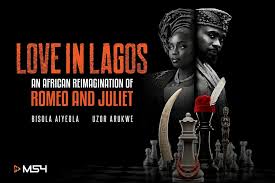
With Love in Lagos, M54 Studios brings the spirit of Nigerian pageantry to the heart of South East London. Romeo and Juliet has been adapted, retold and revived more times than anyone could count, yet this production finds a new dimension within the text, reshaping it into something between pantomime, historical tragedy and folktale.
Mention Romeo and Juliet to anyone and they will no doubt point to the familiar themes: star-crossed lovers, feuding families, inevitability of fate. Director Mofe Duncan transplants these well-trodden throughlines to 1960s Nigeria, specifically the first of October, the day when the country cast off British colonial rule, marking the dawn of newfound independence.
While the play broadly follows Shakespeare’s structure, it is never derivative, nor afraid to depart radically from the canonical text. The feuding houses are two powerful bloodlines – the Yoruba Adeyemis and the Igbo Okonkwos – vying for a federal constituency seat in Lagos. As with the original play, a son and daughter of these rival families meet and fall for one another before learning each other’s surnames. By the time this truth emerges, it is too late for them to simply untangle themselves from each other’s lives as lovers and they both are wracked with the gravity of this reality. Should their families discover their affair, it would unleash a war that could tear through Lagos. You might expect a version set in this period to belabour the political significance of colonialism and independence but this production chooses to not to make it the defining focal point; instead, the weight of family lineage is explored in great depth. Unlike the Montagues and Capulets, the feud in Love in Lagos carries deeper weight, intensified by tribal division and the high stakes that come with trying to claim a voice in a newborn democracy.
Some may see this refusal to linger in the broader postcolonial context as a missed opportunity, but the direction the play takes instead is just as effective and compelling.
Unlike in Shakespeare’s original, the audience is invited to throw itself wholeheartedly into the action, becoming something like a chorus. Even the band is drawn into the action, reacting to events on stage. At one point a soulful saxophone rendition of ‘My Heart Will Go On’ is drowned out by the audience’s enthusiastic karaoke. The tone throughout the production is resolutely comic, at times verging on satire, as with Chidi, the weaselly cousin of Emeka (i.e. Romeo), played by Ola Makanjuola. For example, in a scene when Emeka confides in his aunt (Princess Adekoya) about his forbidden love, we spot Chidi lurking in the corner, eavesdropping like a classic pantomime trope. This willingness to infuse the play with levity, and to freely reshape its contours and characters, makes for a richer, more folk-operatic experience. With ceremonial drumming and praise poetry expertly performed by the onstage band, this is a production catered expressly towards Nigerian audiences and unashamedly celebrates the tradition of Nigerian art and theatre without feeling beholden to its Western source.
I have a deep appreciation for productions that refuse to be hamstrung by pedantic fidelity to the canon; every retelling should brim with as much joy as this one. That joy more than compensates for the technical mishaps, the rough-around-the-edges feel, and a running time that stretched well beyond what was advertised. There is no stuffiness or frigid politeness here.
Through every technical hiccup, the cast remain committed and true to their characters. Bisola Aiyeola as Kitan (Juliet) and Uzor Arukwe as Emeka (Romeo) capture the smouldering intensity of forbidden love perfectly, with Aiyeola in particular never shy to turn her piercing gaze on the audience, as if letting us in on the secret. Together they hold the balance between comedy and the very real stakes of their situation. Their love is never depicted as rash or reckless. Rather, we feel deeply the burden it places on their shoulders and their hearts. By the time they have their first kiss, we are utterly sold on the romance, dreading what we assume will be their inevitable deaths (which, mercifully, do not unfold in the exact same way as Shakespeare originally plotted). For all the comedy imbued in this show, none of the performances tip into excess. Special mention goes to Adekoya and Oluwaseyi Classic as Kayode, Emeka’s fantastically flamboyant best friend, both of whom master that comic register and keep us captivated throughout.
Gateway House in Woolwich may have been a trek to get to for most of the audience, but it proved to be a fitting home in which to watch this show. The company, which previously toured this show in Manchester and Coventry, makes excellent use of the church hall, and though the play itself might be largely free of Christian themes, the space itself fosters a sense of community spirit: church, after all, draws people together much as theatre does.

