Categories
Theatre

Foxes

Foxes


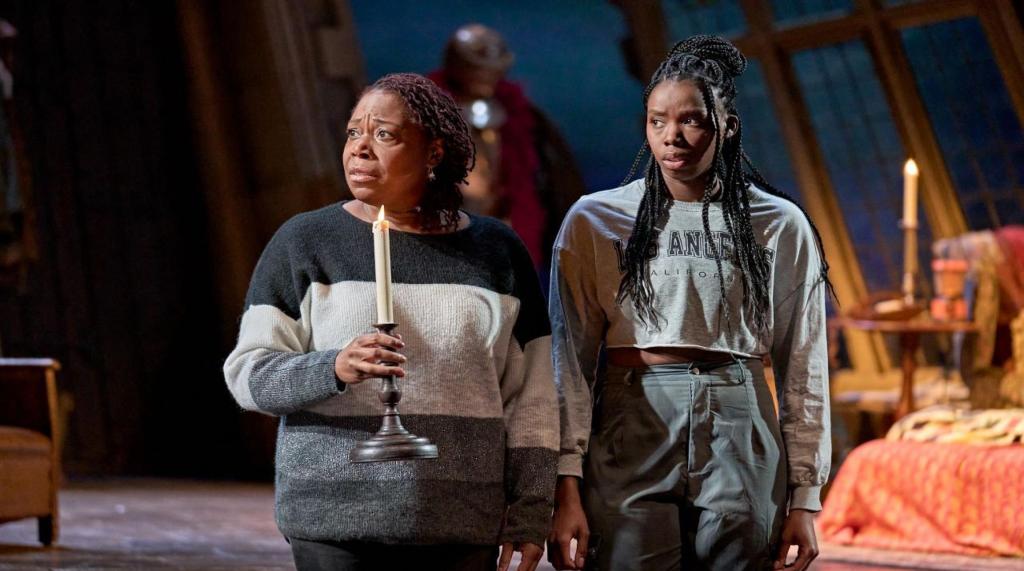
Foxes Production Photo (Credit: Adam Yemane)

Foxes is a simple and poignant story about how twenty-year-old Daniel’s coming-out affects his relationships with his best friend, his girlfriend, and his Caribbean family. With the rhythmic slang and vitalising grime, afrobeats, and dancehall segues, writer Dexter Flanders has captured an authentic slice of Black British life in North London. Director-and-producer James Hillier’s influence is felt in the parts of the production which aren’t to do with language – the scenes and their changes that double as physical theatre routines. These airy scene transitions are incongruous to the raw social realism of the language and acting. 

Take for example Scene Two. It is written in the published October 2021 edition as:

Daniel’s dreaming, he’s in a big black cave. Hands and feet chained. He’s stood star-shaped covered in tar, wearing only rags as underwear. Thunder and lightning roar through the sky. In front of him lies a baby wrapped up in a cot crying. The crying gets louder and louder. Daniel is petrified, he attempts to break free from the chains to help but can’t.

This is thematically more conceptual than the scene prior to this where Daniel has been told by his girlfriend, Meera, that she’s pregnant and keeping the baby. This passage is rife with rhetorical devices, such as pathetic fallacy, which can help the reader infer what Daniel’s reaction to the pregnancy may be. For example, the thunder and lightning is symbolic of the wider existential crisis that this pregnancy presents. It seems like the thunder and lightning isn’t actually a danger to the baby – it’s more like the baby is symbiotic with the weather and they’re working together to oppress Daniel.

However, we don’t need such heavy subtext on stage where Michael Fatogun’s acting and reacting to July Namir (Meera) in the first scene relays a lot of this information. On the Theatre Peckham stage, design constraints meant a lot of this second scene couldn’t be staged. Instead, Fatogun stands, dressed in all black, in the middle of the room, jerking and trying to rid himself of imaginary chains. We have moved abruptly from a slice-of-life kitchen-sink drama in the first scene to a staccato symbolic performance which stagnates the piece as a whole. Thankfully, this staging reins in the script’s initial cave concept.  

While Hillier is an experienced director and actor, it seems like his BBC soap operatic background is not the experience needed for the staging of lived Black gay experiences. However, Josh Anio Grigg’s brilliantly unnerving music design and the direction of the actors’ movements and body language tempers the potential melodrama of the last scene:

Daniel looks to the door and then puts his head on Leon’s leg […] Daniel and Leon like clockwork both re-adjust and create distance between them. Daniel picks up Nevaeh. The rest enter with the cake, singing happy birthday and they all join in.

The urgency with which Fatogun and Anyebe Godwin (Leon) ‘create distance’ as the family come in, completely oblivious, is heart-breaking and speaks volume, especially set against the non-diegetic music. In creating distance, Fatogun stands completely by himself on the stage, signposting his alienation from his family. We feel the sense of danger of having their sexualities be revealed. They look at each other, sad that they cannot openly be happy together and, unlike in the script, Daniel does not pick up Nevaeh, Getting rid of that moment of intimacy for the character suggests that his clear priority and love in life is Leon who he touches and that Nevaeh is a product of, and burden carried over from, a life Daniel wishes he didn’t have to have. 

The acting in this last scene shows the realities of being in the closet in a Caribbean household. The illicitness and clandestineness codes these characters as criminals even though they’re simply in a relationship. This  is an uncomfortable reality for many people. If only there were more of those brilliant flashes of direction from Hillier and less of the physical theatre fluff. If anything, you should watch this show for the last scene alone. 
Categories
Theatre

Manor

Manor


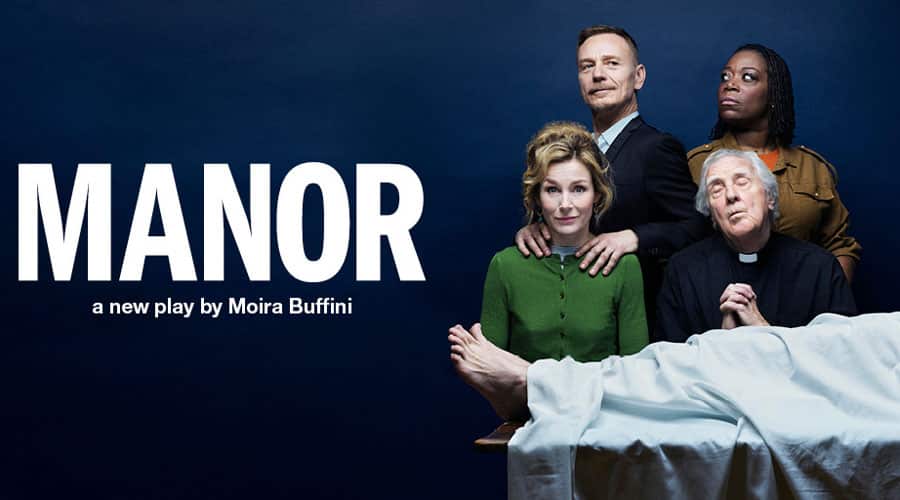
Manor Production Photo (Credit: Manuel Harlan)

When?

16 Nov 21 – 1 Jan 22

Where?

Upper Ground, London SE1 9PX

Book tickets here

On paper, Manor, written and directed by sisters Moira and Fiona Buffini respectively, is a provocative and comedic exposé of the state of the nation. In practice, the play produces very few laughs and even fewer lucid analyses of the far-right in modern British society. Manor feels like the theatrical equivalent of a sparkler that has been lit in a torrential rain and hisses and squibs, much to the chagrin of the audience. 

Depictions of torrential rain is one of the few things Manor gets right. Lez Brotherston’s set and Jon Nicholls sound design come together to perfectly emulate the apocalyptic storm that punctuates the play. Lady Diana, the owner of the manor, allows a ragtag group of refugees to shelter with her family during this storm. Among these refugees is a trio (Ruth, Anton, and ringmaster Teddy) from a far-right organisation, Albion, which is in the leagues of Neo-Nazi groups and the KKK. Teddy falls in love with Diana’s manor because, to him, it epitomises England at its most pure (read: white). Because of her title, he falls in love with Diana too. This Lady Diana gag isn’t as sharp as the play thinks – yes, she was part of the most English institution ever, but she was an outsider (which is the reason why so many people of colour relate to Diana).

All three Albion members explain their organisation’s genocidal impulses and how England has been soiled by inferior races, pushing the superior ones to the margins. The issue is they don’t really talk about race in any meaningful way. Instead, when Teddy hits Ripley, a Black Nurse, he shouts, ‘you people are fucking Pharisees’, this feels like a damp and vague attempt at racial tension. At one point, we get the pleasure of watching Teddy radicalise Perry, a caravan-dweller who’s recently been made redundant from Sainsburys and who is the butt of many unfunny fatphobic jokes. When incited to say what he feels about his Sainsbury’s manager, he says the P word. This use of this slur can’t even be called inflammatory because the entire scene has no emotional charge or lead-up. Rather, it’s an awkward stab at depicting how racial politics lies at the heart of the far-right’s recruitment and ethos. Maybe Moira, of Irish descent, has no intimate understanding of how radicalised young people, amongst their peers, feel confident enough to commit hate crimes and racist attacks against global majorities.

Moira has the opportunity to parody far-right ideology throughout the three different characters. Each character has a different identity marker which allows for individualised ‘recruitment’ speeches. Ruth focuses on the white woman’s role in Albion while Anton speaks for people with lived experience of the prison system and Perry for disabled people. 

Anton’s rhetoric is just as endearing as that which is espoused by spokespeople for far-right organisations at rallies, in academia, on social media. However, unlike real-life ideology, in Manor, it is very incoherent and there is little clarity. While this could be a satirical depiction of the far-right, we spend so much time trying to make sense of the words and his argument that the whole attempt at lampooning feels ill-considered and without purpose. 

The implicit explorations of how the far-right operate are far more interesting. We see Teddy recruit people considered ‘weak’ by society – those that are blind, overweight, criminals. However, although he was able to recruit Anton, who, like his US counterpart, is played by a mixed race actor, the organisation is unable to manipulate Dora, the daughter of Nurse Ripley. On the surface, Albion may be inciting a race war but it is clear that this is a war between those with a solid sense of self and those without. For example, Dora is able to see that Anton is just a token. 

Moira affords long speeches and stagetime to the far-right but isn’t able to make us feel anything for those on the right side’. During the interval, I heard one audience member say that ‘the nurse is a neutral character’. This, in a play where this character is the moral centre and hero of the story, is an underwhelming takeaway. Therein lies the problem. These characters act as extras meant only to react to the far-right. Fiona’s direction only exacerbates the superficial nature of these ‘good’ characters.

She has not, it seems, encouraged the actors to non-verbally react to the dangers of terrorism they see in front of them, except for when they have a quirky one-liner to say (Isadora glibly retorts that the world is being destroyed by ‘hormonal white men’). For example, as Teddy croons about Diana’s superiority to other women, Ripley simply walks past with no reaction. After the Reverend reveals that his ‘father saw first hand the horror of white supremacy’, the other characters don’t react. They just walk away and the play steamrolls onto a different conversation.

We get no resolution whatsoever. Instead, these quasi-Antifa characters feel like Chekhov’s unused gun.

Categories
Theatre

The Wife of Willesden

The Wife of Willesden


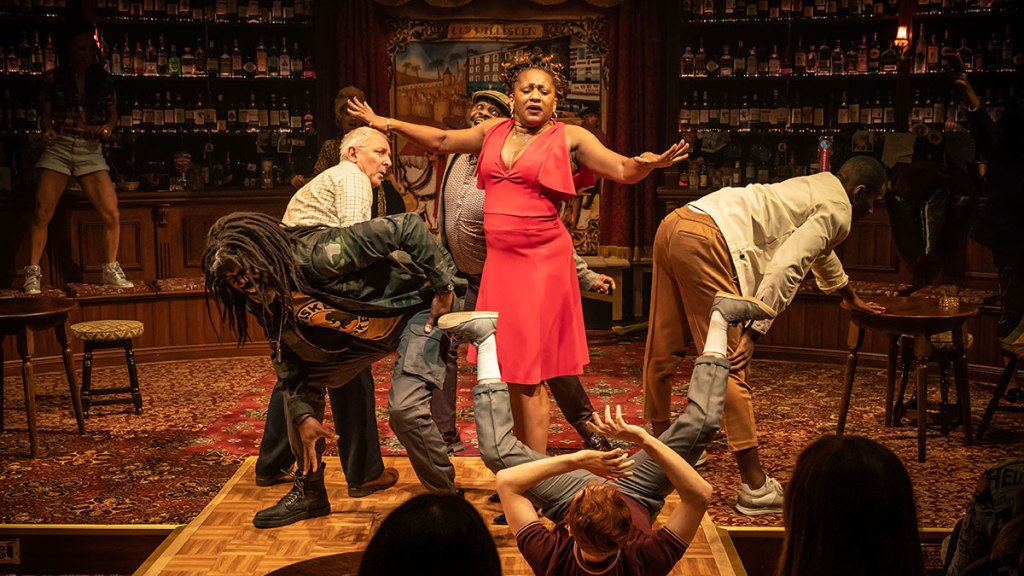
The Wife of Willesden Production Photo (Credit: Marc Brenner)

When?

26 Nov 21 – 15 Jan 22

Where?

269 Kilburn High Road, London, UK, NW6 7JR

Book tickets here

The Wife of Willesden, Booker Prize-shortlisted novelist Zadie Smith’s debut play, celebrates the borough of Brent after being awarded the London Borough of Culture in 2020. Like part of Chaucer’s Canterbury Tales, the play is set in an inn – the Sir Colin Campbell Pub on Kilburn High Road. However, Robert Jones’ set, with its kitschy lampshades and beautiful dark wood paneling, feels a lot cosier than Chaucer’s Tabard Inn must have been. The pub feels familiar for those who live in North West London and those who don’t alike – a feeling that can be maximised if you choose the option to sit on stage as if you’re one of the pub-goers. These pub-goers are celebrating their borough’s recent award with a lock-in and a night of story-telling.

In this enthusiastic reinterpretation of The Wife of Bath, Clare Perkins, of Eastenders fame, exudes sex appeal and charm as Alvita, a Willesden native and five-time wife. While Perkins does have a larger-than-life presence and great verbal dexterity to pull it off, Alvita’s ‘prologue’ is (thankfully) not just a 60-minute monologuing of Chaucer’s 860ish lines. While Performs discourses about power, sexuality, and gender norms in society, she interacts with the ensemble cast of pub-goers. The best moments of the play were when Perkins interacts with the other actors while proving her many ‘feminist’ points. It would have been great to see more of the relationships between the different ensemble characters (we catch a glimpse of this when there is a brief argument between the preacher (George Eggay) and the bailiff (Andrew Frame)) and not just their relationships to Alvita. These interrelationships would fit with the spirit of Chaucer’s Tales – Chaucer arranges the tales so that their themes speak to each other, for example the Wife’s tale forms part of a larger ‘marriage group’ of tales. 

Nevertheless, The Wife of Willesden is a sprawling and ambitious project. Despite the multi-rolling, there isn’t that much variety in the actual action. Even the comic gags and asides became a bit redundant after the first few times.

Apart from the set change which transitions us from the London pub to 18th century Jamaica, there wasn’t much of a difference tonally between the prologue and the tale. In this sense, Smith’s debut play is similar to her debut novel, White Teeth, which could have also benefited – by her own admission – from intentional streamlining. However, here in the Kiln theatre, it’s not that there needs to be less storylines but rather more – the prologue would have felt noticeably drawn and insular. This is fine when reading Chaucer but as a piece of theatre, dynamism is key and Indhu Rubasingham’s staging can only add so much of this. 

As mentioned, Smith has updated the setting of The Wife of Bath’s tale from the Arthurian courts to 18th century Jamaica. Jamaica is where Alvita hails from – however, apart from this reason, there is no real rhyme or reason for why this particular location has been chosen. This is a larger problem with this production. The fact that Chaucer’s Alison hails from Bath, a cloth-making town, is important to her overall character and presentation and is the reason for the stylish way she dresses and her ‘high maintenance’. We don’t get that sense of intention here – Alvita is from Willesden but seemingly only because it allows for stylish alliteration in the title. Even the nods to Kilburn throughout the prologue feel facile. Without the quick mention of the 98 bus which goes through Kilburn High Road, this play could be set anywhere in London. I left the theatre not really understanding what makes Brent the London Borough of Culture. 

This production is of course an adaptation of Chaucer but risks feeling like a prostration. Smith inserts a surrogate who bookends the production with an apologetic admission that she’s paying a debt and that this is her first stab at theatre. This is something Chaucer himself does. However, Chaucer doesn’t shy away from playing with and debasing the classical texts that he pays homage to throughout his oeuvre. However, Zadie dares do nothing of the sort. In the end, this makes the play feel like one giant literature project, as if an English student has been told to reinterpret The Wife of Bath for extra credit. 

Categories
Theatre

Black Futures

Hand in hand with the performing arts comes recording and documenting it. There are many national archive collections, some of which are specifically for the preservation of black theatre, such as the Black Plays Archives. Even though they’re being documented for the future, these diverse Black legacies are being homogenised and compared to White performance history. Black Futures is the complete opposite. It’s actually rejecting this archiving landscape entirely and is set in an alternative world instead.

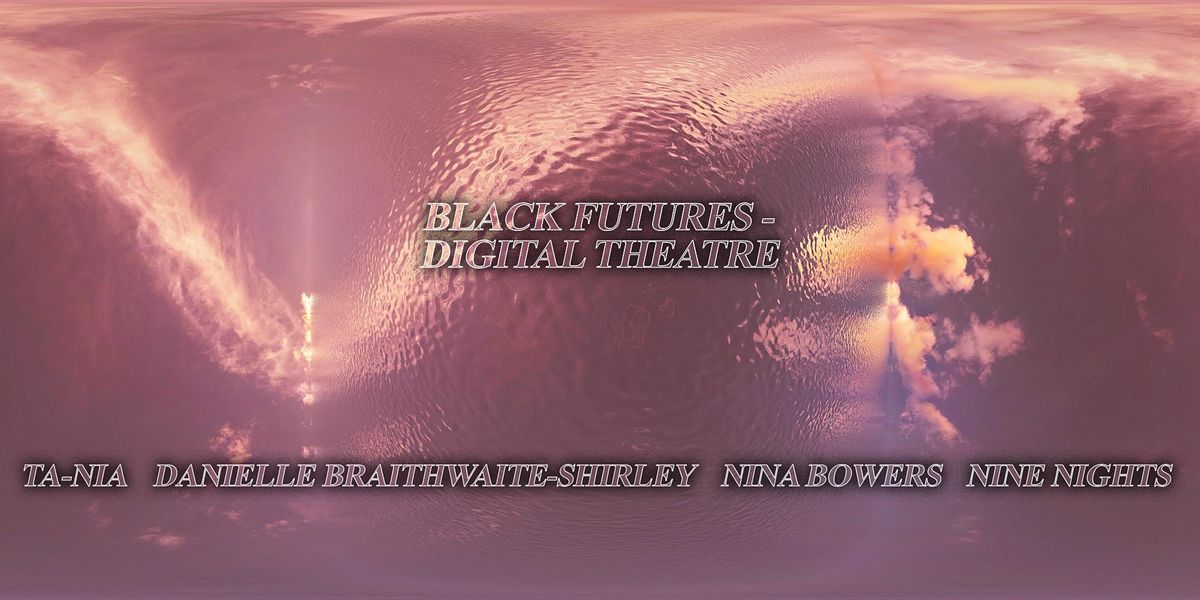
Black Futures is an immersive website which showcases the work created by Danielle Brathwaite-Shirley, Nina Bowers, and Nine Nights. The content is about Afro-centric experiences across different mediums, times and places. In this sense, Black Futures is more like a speculative anthology like Mothership: Tales from Afrofuturism and Beyond, edited by Edward Austin Hall and Bill Campbell. Entering the website makes you feel like you’re discovering new worlds within a tiny island. 

The website is a VR performance piece in and of itself – but it’s not the smoothest experience. It feels like a rudimentary and psychedelic version of Google maps or Minecraft where you get to direct yourself. Unlike a literary anthology, you can easily spend so much time trying to navigate the website that you aren’t able to watch the content in quick succession and then you lose the sense of curation. 

It took a while to figure out that you have to use the direction keys to turn left and right. Luckily, there are hyperlinked pictures at the bottom you can use to directly get to different areas of the island and find the content on the website. Maybe these can be captioned so people know exactly what content is where.

The website’s theme of creating a whole new world is emulated in Brathwaite-Shirley’s video game, ‘Into the Storm’. Regarding what drove her to create this alternative world, Brathwaite-Shirley commented that there aren’t any adequate Black trans spaces on Earth so she made one beyond it. Brathwaite-Shirley’s command of free and amateur technology, such as the motion capture and 3D animation, is commendable. Her video game is a brilliant example of commissioning the right type of ideas for this sort of website. However, you have to exit the website and go onto YouTube to actually choose the next chapters in the video game. Unfortunately this interrupts the overall immersive experience of the website so it may not be the right space for interactive content. 

Through their curation, Anthony Simpson-Pike and Rose Elnile have platformed thoughtful artistic practices, from artists who wouldn’t get a chance to be commissioned in a normative White dominant society. These artists were only given a week and there are only three pieces so far. As more content gets added, there could be other islands so that the content could be grouped thematically such as a music island, a video game island, and a short film island. Right now, there is a risk of sensory overload with the brightness and abrasiveness of the colours on the website. There should be an option to navigate the website in grayscale. It would be great if there were estimated viewing times or a note of how long each video is or even how many videos there are in total so you don’t feel so lost as to where to start or stop. These areas of improvement will engage a wider audience and help disseminate Black Futures’ message further: it is decolonising the performing arts landscape and archive.

Categories
Theatre

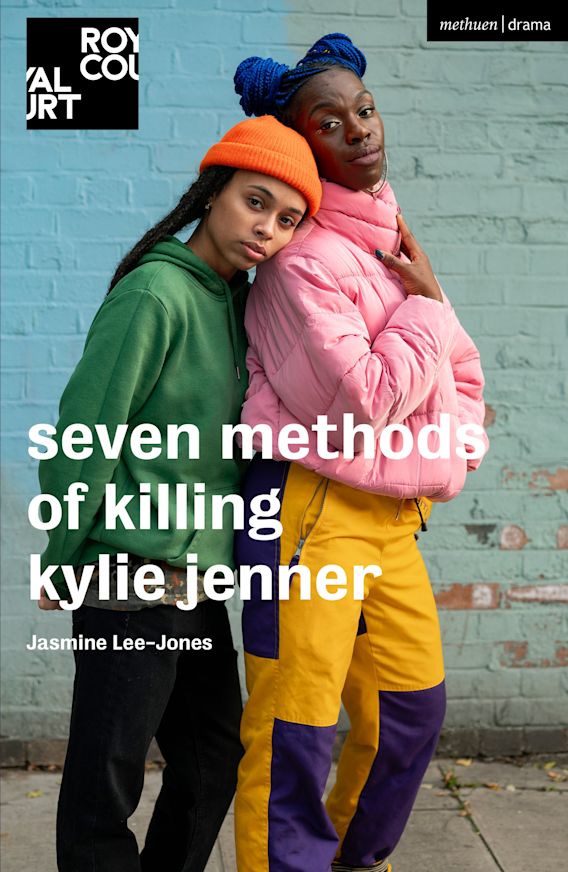
seven methods of killing kylie jenner

seven methods of killing kylie jenner


seven methods of killing kylie jenner Production Photo (Credit: Myah Jeffers)

The Royal Court Theatre prides itself on cultivating emerging writers and voices who have something to say about the State of the Nation. The premise of Lee-Jones’ debut, seven methods of killing kylie jenner,  definitely lives up to the tradition of Royal Court Theatre’s ethos of championing unorthodox, unconventional political plays.

This is in many ways a morality play on Blackness and the many identities within this, such as queer Black people and dark-skinned Black women. However, Lee-Jones’ discussion about rich white American influencers profiting off Blackness while discriminating against the women they copy feels foreign on a British stage. Running at 90 minutes, the play is chock full of one-liners, fit for a 240 character tweet, and theoretical buzzwords. At times, it feels like skimming  from discourse to discourse (from misogynoir to homophobia in Black communities) stops the audience from ever becoming critically engaged with the matters at hand – not a problem necessarily, except for the majority of the audience is white. Leanne Henlon’s ability to glide through the dialogue as Cleo brings to life what could easily be clunky dialogue. Reading that this production was a revised script has me worrying what the pace of the earlier seven methods must have felt like?

seven methods is commendable for its astute and fervent commentary on race, gender, and class (in America? In Britain?), but is always on the verge of sacrificing substance for style, especially when it comes to the Twitterludes. Turning the platform Twitter into a physical space is no doubt a difficult feat, and has been rendered innovatively in this production. Director Milli Bhatia’s interpretations of these Twitterludes are fun, even if the different accents that Cleo and Kara switch between aren’t always comprehensible, and even if it gets a little hard to separate between the quote tweets, the replies, the gifs as the speed and intensity ramps up during the production. In many respects, though, this edge on which you feel during the Twitterludes emulates the feeling of missing out on the latest Discourse on Twitter because your phone has refreshed too quickly. Rajha Shakiry’s set design infers this as well – as the ropes begin falling from the huge tree that dominates the stage, racists find her tweets, the death threats against Cleo snowball and she loses all control. 

If you’re well versed in Black Twitter/Tumblr, then this is the play for you.